
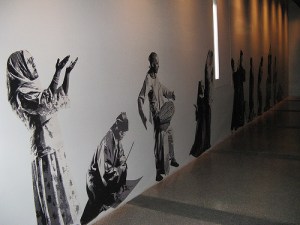
If you are ever in Taipei, do not pass up the chance to visit the unique Museum of World Religions. You will have to leave the comfort of the English-friendly subway system and take a shuttle bus from an unmarked-in-English bus stop to the mall where it resides. My Lonely Planet Southeast Asia on a Shoestring promised that it would have depictions of ten of the world’s most influential religions, but with a street-front entrance attached to the side of a mall, the museum did not look like much. I had faith in my yellow bible, and I’ll-be-damned if it wasn’t right.
The museum begins with a glass-pane waterfall and description of the concept of purification in various religions. Next is the Pilgrim’s Way with philosophical questions (in Chinese and English) projected on the walls:
What is consciousness?
What was I before I was born?
Why is there memory?
Who am I?
The Way (…or Dao) ends in the Golden Lobby where the museum has created a combined cosmology on the floor. The cosmograph is a labyrinth of symbols and colours held sacred by various religions. I was hoping that the gift shop would have had a depiction of it—otherwise I would have taken notes and/or photographs. Unfortunately, no gifts resembled the remarkable wheel.
The museum’s other highlights are a short film of creation myths; a collection of religious artefacts and replicas; stunning models of famous temples; detailed descriptions of Islam, Judaism, Buddhism, Ancient Egyptian, Christianity, Shinto, Mayan, Daoism, Sikhism, and Hinduism; a meditation gallery; and a room with video clips of famous religious leaders discussing their faiths. Jane Goodall talked about chimps and their waterfall rituals which look like the beginning of Animism; a Hindu said—quite rightly—that the question is not “Who am I?” but “What am I becoming?”; and another Hindu had an intriguing idea about the mind as energy. Because we are composed of atoms and subatomic particles constantly giving and receiving energy, he argued that consciousness is ancient and the mind (as energy) is indestructible. “No other entertainment is necessary when watching one’s own consciousness. To be in the state of a smile, love, peace, and awareness. It’s all about knowing yourself.” The Buddhist creator of the museum also spoke on the video, as did a First Nation’s Canadian who talked about the “other world” he has seen when communing with the Grandfather Tree in the forest.
The museum did a splendid job of showing the similarities between religions and the value to be found in spiritual faith (although I still believe it all comes back to philosophy—all the god nonsense can be cut out). I feel so fortunate to have stumbled upon that exquisite museum of tolerance. As the Golden Lobby’s pillars say (in fourteen different languages):
Love is Our Shared Truth
and
Peace is Our Eternal Hope

 write with lightning
April 7th, 2010 at 13:12
Thoughts? Take a stab at answering any of the questions from the Pilgrim’s Way. In a comment would be lovely, but to yourself, just as good.
April 15th, 2010 at 15:11
What is consciousness? The awareness of need. The amoeba’s cilia moving in tandem. Two individual heart cells that, placed in a petri dish, pulse together. A George Eliot novel read in slanting sunlight on a Calgary afternoon in panicked anticipation of a professor’s frown. A shout in the early morning. A fold in the rug on the doorstep and tufts of fur under the fir tree.
What is unconsciousness?
Operating a cash register.
April 15th, 2010 at 15:39
ㅋㅋㅋㅋ! Well said.
April 15th, 2010 at 21:12
“i will not die; it is the world that will end” — by ???
the quote works in reverse: “the world didn’t exist before i was born”
for karen armstrong humans are meaning-seeking creatures that give reasons for compassion, peace, and love. and so we have religions which teach compassion, peace, and love while pitifully failing to achieve any of these. sorry, lady.
if you NEED something mysterious, daoism is the way to go. just solitary meditation and individual progress. not many pretensions of what lies beyond, no busybody rules about my life, and no wizened clerics pointing a finger in my face to tell me that it’s impossible for me to be happy unless i prescribe to their formula.
April 16th, 2010 at 22:10
For anyone interested in learning more about Daoism, read the Tao Te Ching by Lao Tzu.
For Canadians:
http://www.chapters.indigo.ca/books/Penguin-Classics-Tao-Te-Ching-Tzu-Lao-D-Lau/9780140441314-item.html?ref=Search+Books%3a+%2527lao+tzu+penguin%2527
For Americans:
April 17th, 2010 at 08:27
already read it! five stars! less preachy than something like “the dhammapada”. i back writewithlightning’s recommendation.